| 'INDIEN' - AN AUSTRIAN ROAD MOVIE | ||||||||||||||
|
Although towards the end of 'Indien' the touching story gets more and more serious, the first half of the movie is one of the most telling satires ever penned on Austria and the idiosyncrasies of its inhabitants. Considering the 'Americanness' of the road movie in general it seems almost impossible that a movie so 'Austrian to the bone' as 'Indien' could ever fit into the same genre as its American predecessors. Yet, a more detailed analysis of the film clearly shows that almost all specific features and stock situations of the road movie listed on the previous page come up in 'Indien', although most of them in a modified version. |
||||||||||||||
Concept of Modification: Scaling Down |
||||||||||||||
|
A very simplified thumb-rule for this modification would be that, since Austria is a small nation and the United States is a huge country, all of these concepts are taken over on a much smaller scale. Whereas heroes in American road movies are literally traversing a whole continent and driving thousands of miles, this is of course not the case in Austria. In our particular case of 'Indien' the area is confined to an even smaller region (certain parts of lower Austria) and Bösel and Fellner are probably making a hundred kilometres a day, at the most. If we juxtapose 'the classic American road movie' and 'Indien', we might end up with a table like this:
| ||||||||||||||
This concept of scaling down is one of the basic keys to the humor of the movie. Although the film draws most of its comic effect from a situation where to people disliking each other are forced to share one car, I would argue that the constant playing on typical road movie situations and the permanent scaling down of patterns until they are reduced to a ridiculous size also contributes its share to make the movie the hilarious satire it actually is. 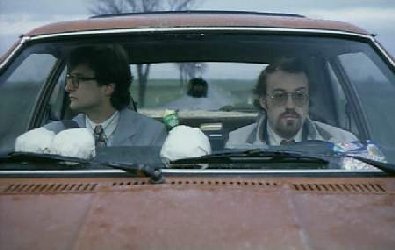
Alfred Dorfer and Josef Hader hit the road as Fellner and Bösel The list below is by no means complete, but makes it possible to point out which features 'Indien' shares with its American predecessors, how the concept of modification is applied and in which scenes Dorfer and Hader were deliberatly playing on and with core values of American identity. |
Some Stock Situations and Concepts of the Road Movie in 'Indien'
| The Road: |
It goes without saying that a road movie needs a road. Traditionally, road movies were set on highways or freeways in the countryside,  but urban road movies like "Taxi Driver" have come to question this assumption more and more recently. but urban road movies like "Taxi Driver" have come to question this assumption more and more recently. Nevertheless, as most movie theorists agree that the road movie is the modern offspring of the western, the protagonists' journey on the road is generally believed to have taken on the role ascribed to the frontier in the western: both, the frontier as well as the road, are placed outside the bounds and limitations of society and thus become a unique testing ground where protagonists battle for personal freedom and justice. In 'Indien' much of the action is set on the road and many of the crucial scenes take place either in or near the car. Like in traditional road movies, the road functions as a place where the protagonists can free themselves from social boundaries, act out their aggressions, and transgress at least some restrictions of our tightknit society such as speed limits or drug laws. 
|
| The Vehicle: |
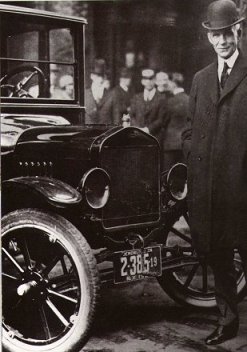 Certainly not every film in which cars appear is a road movie, because cars come up in almost every film set in modern times. To make the film a road movie, cars have to have a certain significance.
 Obviously cars not only play a central part in road movies, but also in American every-day life. Although originally invented in Germany, the car has gained an importance in the US that is globally unrivalled today. And it is certainly not a coincidence that the United States was the first country where the car developed into a means of mass transportation. This in turn, is to a large extent due to Henry Ford and his Model T, which sold 16 million pieces between 1908 and 1927 and paved the way for cars in general in the United States. Given this background information, we may ask with good reason: What type of car is Bösel driving in 'Indien'? And we should not be too surprised to find him actually driving a FORD Taunus! Although this might as well be a mere coincidence, I dare say that Bösel's car was not randomly chosen, but with the intention of deliberately playing on American history. The general preference for posh, American cars and motorbikes in American road movies also ties in with the topic of patriotism. |
|
|
| The Journey: |
|
The journey serves as a link between the road and the vehicle and becomes the central motif of the road movie: it gains a symbolic character similar to that which is ascribed to the frontier in the western. Journeys in road movies are not only mere transportations of the protagonists from A to B so that they can carry on acting there, but the journey as a process takes on a meaning of its own. Typically the journey does not come to an end because the hero arrives at his final destination, but because of some event, for instance the protagonist's death, illness or running out of money. Just as the two 'Easy Riders' are shot in the end, the journey in 'Indien' is also ended not by the last Schnitzel being tested, but by Fellner's injury and, eventually, his death.
|
| The Landscape: |
Typically the protagnists travel through a rather forlorn and desert-like landscape to make it clear that they remain outsiders in nature and are totally dependent on their car; the most typical road movie shot is probably one of vast plains cut by the straight line of a freeway running up to the horizon. As barren and desert-like areas are not exactly the type of landscape Austria is known for, trying to achieve an effect of vastness was certainly one of the most challenging aspects about making the film. Having set the movie not in a narrow Tyrolean mountain valley but in the comporatively 'vast' plains of Lower Austria, high camera positions and shots of oil rigs in the sunset do indeed create an atmosphere that is reminiscent of Texas rather than of Austria.
 Although these tricks help to achieve shots that are similar to those of classic road movies, they cannot change the fact that deserts and rattle snakes are something you can hardly find in Austria. Therefore, the concept of the vast and threatening landscape had to be modified in order to achieve the same effect: in 'Indien' something as trivial as rain instead of deserts is used to point out how dependent the protagonists remain on their car (and on the car driver!). When Fellner has had enough of Bösel's risky overtakings and decides to abandon the rusty Ford for good, a boringly normal cloudburst is already sufficient to make him change his mind.
|
| Violence and Destruction: |
| As it did in the western, violence certainly plays an important role in the road movie as well, but appears in a different form. While in the western the frontier setting provides a fictional justification for enjoying countless gunfights and shootings, the road movie is set in present-time and violence in road movies is therefore, in contrast to the western, heavily questioning values of modern society. As a result, violence in road movies takes on a more subtle form: instead of conventional guns or knives, the vehicle is used as a weapon. Driving recklessly, many protagonists ignore every obstacle they stumble on and break through road blocks with a persistence that is impressive. This is also true for Bösel and Fellner, but once again only in a modified, i.e. smaller, version. While in American road movies huge trucks may easily become powerful weapons, Bösel's rusty Ford is not at all designed to create an impression of danger, but, as can be seen in various scenes of the movie, in combination with Bösel's driving technique it is enough to at least scare the hell out of Fellner and, supposedly, the oncoming driver as well. There are, however, also more open forms of violence in solving conflicts, such as beating up and fist fights among the hero and his enemies or even among people who are becoming friends later on, a pattern which can also be found in 'Indien'. Violence in road movies is often connected to the protagonist's striving for personal freedom.
|
| Theft and Other Illegal Actions: |
| Violating of traffic regulations like speeding, but also the consuming of drugs (or beer in Bösel's case) while driving are typical 'crimes' committed by the road movie hero, because they are considered a national sport rather than serious crimes. As a result, the audience is still able to identify with the protagonist and to see him not necessarily as a law-abiding, but basically 'good' character' although he is, strictly speaking, doing something illegal. In classic American road movies the committed crimes may become as serious as bank robbery or even murder, crimes that would be way to serious for Bösel and Fellner. Nevertheless they cannot be regarded as simple 'road ragers' ignoring red lights and speed limits, but it becomes obvious in the film that they are also more than open to bribery, which is an illegal action for sure.
|
| Typical Locations: |
| Dorfer and Hader, portraying two employees of the Lower Austrian tourist office, are definitely spending their time in places that would be considered typical locations for a road movie. During their tour through lower Austria they visit one hotel and bead-and-breakfast after the other and spend every night in another village, very much like American road movie protagonists stay in motels and similar types of accomodation.
|
| Patriotism: |
| In American road movies patriotism is explicitly expressed in posh cars and motorbikes of preferably American origin. Although Harley Davidson accounts for less than ten percent of the market (some 7% in 1991), you hardly ever see the protagonists of a road movie drive a European or Japanese motorbike on the screen. The same is true for cars. If non-American cars appear at all in a road movie, it is only for the sake of ridiculing their drivers and the foreign equipment. The Austrian manifestation of Patriotism in 'Indien'is, apparently, the Schnitzel. But Patriotism - if not to say nationalism - is also evident in Bösel's aggressive reaction to Fellner's statement that the name 'Bösel' might have a Slavic origin. In this case, however, I'm not sure whether this is really a reference to the road movie. I'm more inclined to interpret this scene as the direct mocking of a typically Austrian form of xenophobia than to interpret it as an indirect allusion to something that is typically American.
|
| Gambling, Bets, and Races: |
| A more ritualized form of solving conflicts than simple violence are bets, races and gambling which lead up to competition: it is characteristic for protagonists in road movies that they are born gamblers, always in search for cheap thrills and despising security. Games, bets, and races as a way of comparing skills also serve to solve conflicts by determining who is the winner and who is the loser. If we compare 'Indien' with American road movies, where the characters often lose literally all they have (usually in Las Vegas), Bösel's and Fellner's childish competitions in 'Schnapsen' and 'Trivial Pursuit' have to look ridiculous. Once again we find that the concept of gambling, bets, and races comes up in 'Indien' as well, but only on a much smaller and therefore ridiculous scale.
|
| Striving for Personal Freedom: |
| As already mentioned, the road movie hero usually finds himself in a complex society which is contemporary or at least similar to the one in which the viewers find themselves as soon as they step out of the cinema. Those members of society who feel that their personal freedom is being curbed by social restrictions can identify with the protagonists rebellion against these limitations, be it against speed limits or drug laws, and might even envy them for their temporary escape from social boundaries. Thus, the road movie demonstrates how members of society can rebel against restrictions of their personal liberty imposed on them by legal authorities. In the road movie as well as in the western this struggle for personal freedom is marked by violence, but not only conflicts between the hero and those who try to restrain his freedom are solved by physical force. Violence has shaped the westerner as much as the road movie hero. The usual violent form of solving conflicts molds the protagonis's personality in general and fistfights become frequent even among friends or people who become friends later on. As Georg Seeßlen, Bernhard Roloff and Wolfgang Taube point out in their work 'Die Kunst des Western'(1979): |
| In einem guten Western mußten vorkommen: [...] ein Boxkampf zwischen Freunden (oder Leuten, die erst einmal einen Boxkampf austragen mußten, bevor sie Freunde werden konnten). |
| (Seeßlen/Roloff/Taube, quoted in Bertelsen, p.91.) |
| This is also a pattern we find again in 'Indien'. When Bösel is suffering an indigestion after he has had his first orange juice in years and Fellner keeps on talking about rich food (for instance describing chicken in a very drastic manner), the tormented Bösel loses his temper and gives Fellner a violent push. Fellner, in turn, is not seriously hurt but lands quite hard in the muddy roadside ditch. The outcome of the argument is really harmless in comparison to the severe bruises protagonists frequently suffer in Amercian road movies and also the reason why this 'fist-fight' occurs is ridiculous, but the underlying pattern of people fighting each other and later on becoming very close friends is definitely the same.
|
Many thanks to ELA for designing this homepage!
2002 © Anita Wolfartsberger - All rights reserved
BACK TO EASY RIDERS